

Why a frog with a Habsburg jaw is a surprisingly tough AI benchmark
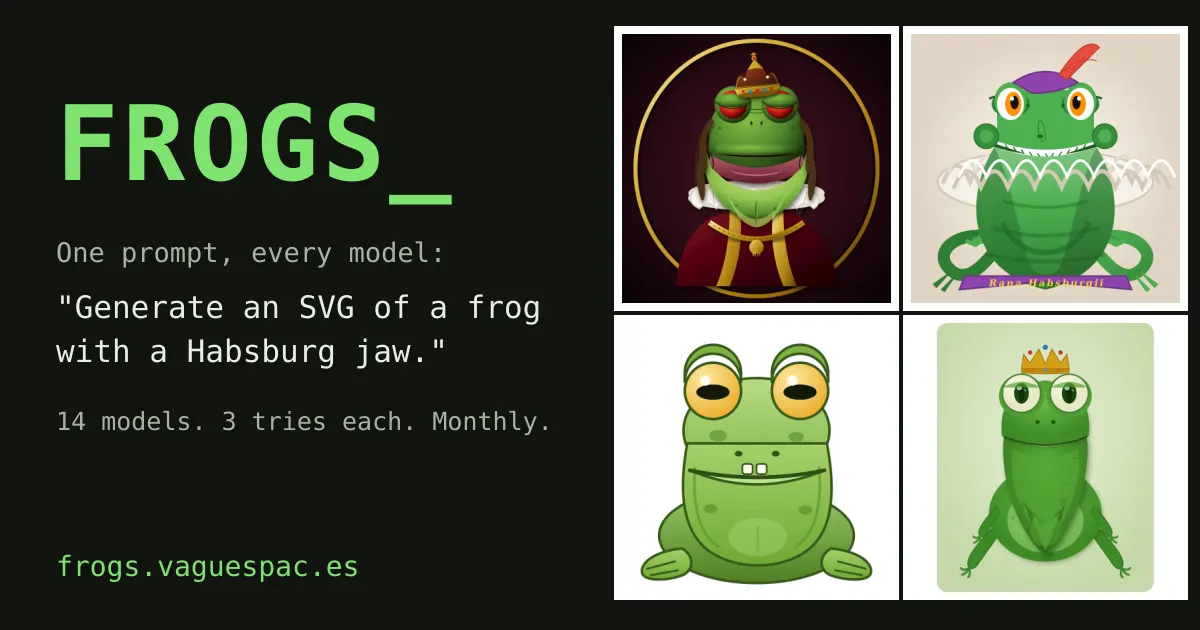
Asking an AI model to render a vector graphic of a frog with a Habsburg jaw sounds like a joke, but it exposes a real limit in spatial reasoning.
A project shared on Hacker News highlighted a custom AI prompt: generate raw SVG code for a frog featuring the infamous protruding dynastic jawline. Instead of sticking purely to geometric shapes, the model editorially bloated the markup—inserting royal accessories like an "Imperial Habsburg Crown" and a "Golden Fleece Medal," along with code comments like "Folded Pompously" and "gloomy expression." It even labeled anatomical features directly in the SVG code as "weak maxilla" and "Belly Plate (Weak chest)."
Why it matters: Generating valid, structured SVG graphics demands precise 2D coordinate planning without visual feedback. When forced to combine abstract historical traits with animal anatomy, models struggle with pure geometry and lean heavily on thematic labels to bridge the gap.
Here's the gist: generating clean vector graphics remains a tough test for text-based models, especially when forced to translate historic human traits into clean XML paths.
Turns out royal genetics are just as messy in raw SVG code as they were in 17th-century Europe.
Sources
- SVG Frog Project — https://frogs.vaguespac.es/
- Hacker News Discussion — https://news.ycombinator.com/item?id=49147622