

Europe’s $2B Mercury probe just dumped its engines for the final stretch
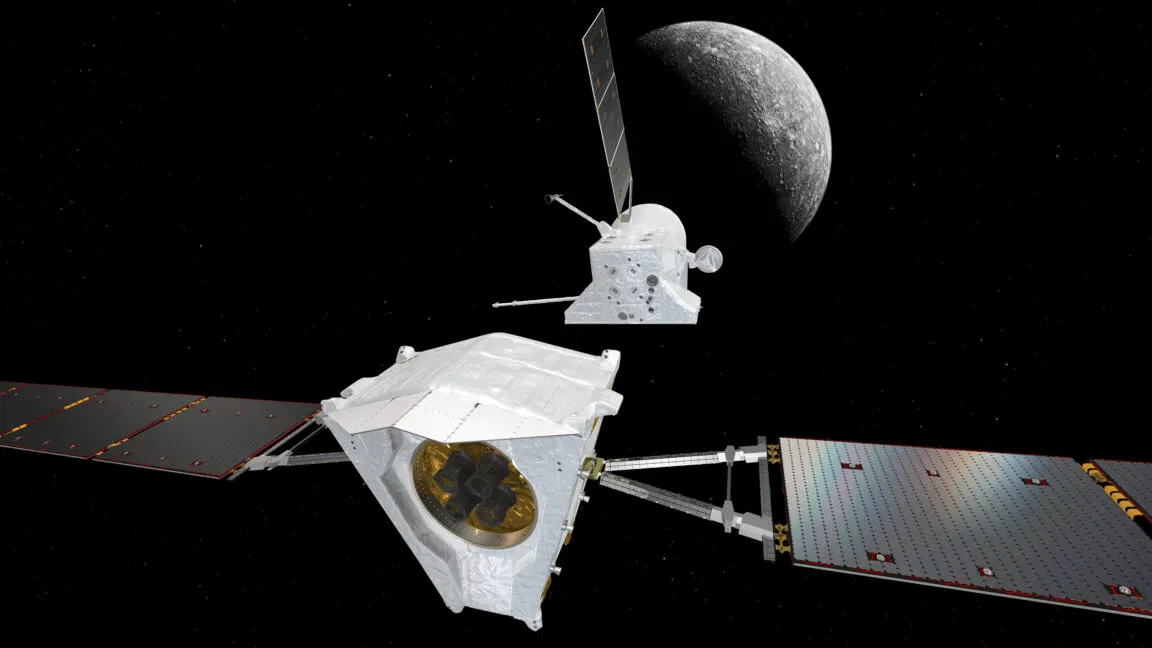
Getting a spacecraft into orbit around Mercury takes more energy than sending one past Pluto.
After an eight-year, 6-billion-mile journey, the joint European-Japanese BepiColombo mission successfully jettisoned its propulsion module on Thursday, Ars Technica reported. The risky maneuver shed dead weight and uncovered hidden scientific instruments, placing the probe on track to enter Mercury's orbit on November 21.
Why it matters: Parking at Mercury is notoriously difficult because of the Sun's massive gravitational pull. BepiColombo needed four ion thrusters and nine planetary flybys just to slow down enough for capture. Shedding the transfer module was required to switch on the craft's primary solar arrays and main cameras for its primary scientific mission.
Know this: BepiColombo is actually two spacecraft traveling together: Europe's planetary orbiter and Japan's magnetospheric orbiter, nicknamed Mio. The pair will separate from each other in December, shortly after entering orbit.
Eight years of interplanetary gymnastics, finally paying off.